
Home / The Dirt / Hydroponic herbs / Growing Chervil Hydroponically
Growing Chervil Hydroponically
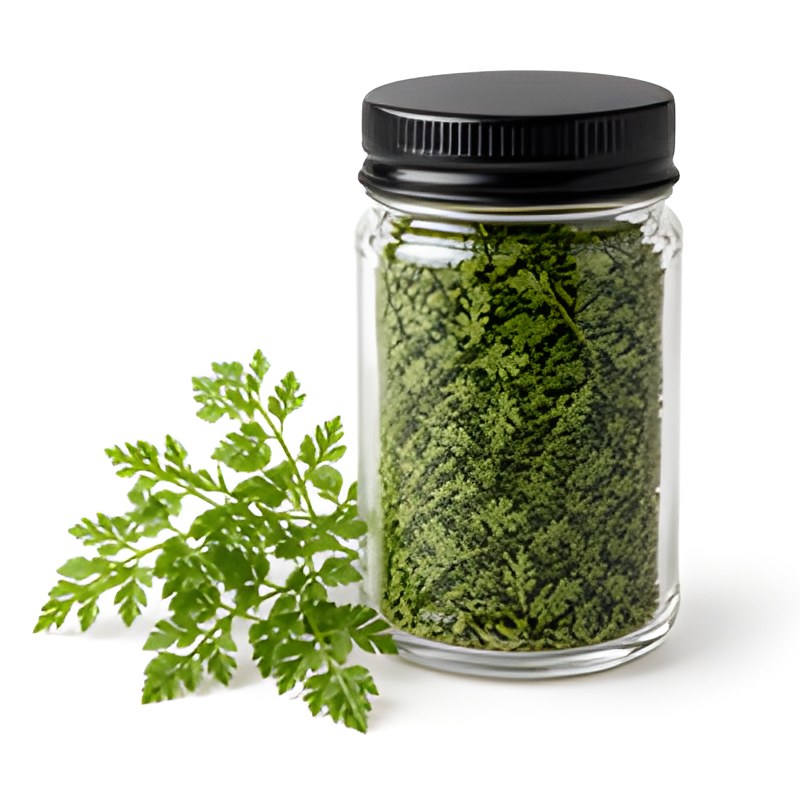
Garden chervil (Anthriscus cerefolium) is a small annual herb in the carrot and parsley family, grown for its lacy, mild leaves. Here's a brief overview of the plant, what is in the leaves, and how to grow it in a hydroponic setup.
What Chervil Is
Chervil is a sweetly aromatic, slightly hairy annual up to 70 cm tall, with thin whitish roots and a branched, grooved stem. The leaves are finely divided, up to three times pinnate, and the lower leaf blades are triangular, 4-11 cm by 3-15 cm. Small white five-petalled flowers sit in umbels 2-5 cm across, followed by thin beaked seeds 5-10 mm long that turn black when ripe (PROSEA).
It is native to south-eastern Europe, western Asia and central and southern Russia, has been cultivated in Europe since the 16th century, and is now grown worldwide (PROSEA). Illinois Extension describes the flavor as a mix of parsley and anise.
Nutritional Profile of Chervil
USDA FoodData Central has no record for fresh chervil; its entry is for the dried spice (SR Legacy, FDC 171318). Per 100 g of dried chervil it gives 237 kcal, 23.2 g protein, 3.9 g fat, 49.1 g carbohydrate and 11.3 g fiber, with 1,346 mg calcium, 31.9 mg iron, 130 mg magnesium, 4,740 mg potassium, 50 mg vitamin C, 293 µg vitamin A (RAE) and 274 µg folate (DFE). It is 7.2% water (USDA FDC via GetFoodFacts). A teaspoon of dried herb weighs very little, so a serving holds a small fraction of these amounts.
Nothing on this page is health or medical advice.
Chemistry of Chervil
The scent comes from a small amount of essential oil. Three compounds make up about 95% of it: undecane, methyl chavicol (also called estragole) and methyl eugenol. The mix shifts as the plant grows: methyl eugenol peaks at about 70% before flowering, methyl chavicol peaks at about 70% at full flower, and undecane rises to about 20% after flowering (PROSEA). That is one reason leaves picked before the flowers open taste different from leaves picked later.
In an Egyptian field trial, adding nitrogen and potassium fertilizer raised both herb yield and essential-oil yield over unfertilized plants, and changed the share of the main oil compounds (El Gendy et al., 2015).
In the US, chervil is "generally recognized as safe" as a food flavoring (GRAS 2279), with a limit of 0.1% of the herb in meat products (PROSEA).
In the Kitchen
Chervil is one of the traditional fines herbes of French cooking, used in soups, salads, sauces, egg dishes, vegetables, fish, cheese and herb butters (PROSEA). Illinois Extension suggests using it much as you would parsley, and as a garnish. Both leaves and stems are used (Illinois Extension).
Hydroponics of Chervil
What the Research Shows
Chervil has very little published hydroponic research. The one figure in the PROSEA plant account is a greenhouse hydroponic yield of 2.3 kg of leaves per square metre after 42 days, and it gives the time from sowing to harvest as short as 6 weeks in a greenhouse, against up to 6 months in the field (PROSEA). We did not find a published study that states the nutrient solution strength or pH used for chervil, so the feeding numbers below come from a hydroponic retailer's guide, not from a trial.
Researchers in Japan worked on keeping cut chervil fresh: sprigs stored at 8 °C under dim red LED light, with a nutrient gel on the cut stems, kept their color about as well over 21 days as sprigs stored in the dark at 6.8 °C (Fujiwara et al., 1999).
Feeding
Rochester Hydroponics, a hydroponic supply store, suggests a pH of 6.3-6.7 and an EC of 0.8-1.8 for chervil. Its guide cites no study, so treat these as a starting point and adjust to how your plants grow. In soil, chervil prefers moist, organic-rich ground at about pH 6.5 (PROSEA), in line with that range.
Light and Temperature
Chervil is heat-sensitive. It grows poorly in hot, dry conditions, needs protection from direct sun, and in the tropics is grown only at cooler high altitudes (PROSEA). The Rochester Hydroponics guide suggests 50-65 °F (about 10-18 °C), with 55 °F ideal and nothing above 70 °F, and 14-16 hours of light a day. Indoors, that makes chervil a good herb for a cool room or a cooler corner of the grow space.
Starting a Plant
Grow chervil from seed; the seed stays viable for 2-3 years (PROSEA). Seed needs light to germinate, so cover it very lightly or not at all, and keep it moist (Illinois Extension). Seedlings are fragile and difficult to transplant (PROSEA; Illinois Extension; University of Maryland Extension), so sow straight into the cube or plug the plant will finish in rather than moving it later. In the field, seedlings are thinned to 7-10 cm apart (PROSEA), or 3-4 inches (University of Maryland Extension).
Harvest
Pick leaves when they are fully open but still tender (Illinois Extension), and before the flower buds open (PROSEA; University of Maryland Extension). For denser foliage, cut flower stems before they bloom (PROSEA; University of Maryland Extension). Chervil flowers readily, so Illinois Extension suggests a new sowing every 3-4 weeks to keep fresh leaves coming; in a hydroponic system, start a few new plugs on the same schedule. Leaves can be air dried and kept in sealed containers (Illinois Extension).
References
- El Gendy, A. G., El Gohary, A. E., Omer, E. A., Hendawy, S. F., Hussein, M. S., Petrova, V., & Stancheva, I. (2015). Effect of nitrogen and potassium fertilizer on herbage and oil yield of chervil plant (Anthriscus cerefolium L.). Industrial Crops and Products, 69, 167-174. Retrieved from https://agris.fao.org/search/en/records/65df82d60f3e94b9e5d95123
- Fujiwara, K., Takaku, K., & Iimoto, M. (1999). Low light irradiation using red light emitting diodes and nutrient gel application for low temperature storage of postharvest chervil (Anthriscus cerefolium L.) [in Japanese]. Environment Control in Biology, 37(2), 137-141. Retrieved from https://www.jstage.jst.go.jp/browse/ecb1963/37/2/_contents/-char/ja (English abstract: https://iifiir.org/en/fridoc/low-light-irradiation-using-red-light-emitting-diodes-and-nutrient-gel-111484)
- GetFoodFacts. (n.d.). Spices, chervil, dried (USDA FoodData Central SR Legacy, FDC 171318). Retrieved from https://getfoodfacts.com/food/spices-chervil-dried-171318
- Nichols, M. A. (n.d.). Anthriscus cerefolium (PROSEA). Pl@ntUse. Retrieved from https://uses.plantnet-project.org/en/Anthriscus_cerefolium_%28PROSEA%29
- Rochester Hydroponics. (n.d.). Hydroponic chervil growing guide and tips. Retrieved from https://rochesterhydroponics.net/hydroponic-chervil/
- University of Illinois Extension. (n.d.). Chervil. Herbs. Retrieved from https://extension.illinois.edu/herbs/chervil
- University of Maryland Extension. (2023). Chervil. Retrieved from https://extension.umd.edu/resource/chervil
Keep reading

Growing Basil Hydroponically
Basil is essentially a herb. But it’s frequently used as a spice in kitchens because of its aroma and peppery taste. Basil is an essential ingredient in Italian and Indian culinary preparations…

Growing Parsley Hydroponically
Native to the eastern Mediterranean region, parsley is now widely used in European and American cuisine. Its leaves are either utilized fresh or dried to form spice. Sometimes, it’s partnered up with…

Growing Thyme Hydroponically
Thyme is a perennial herb that’s rich in nutrition as well as taste. And both these qualities are responsible for their culinary and medicinal uses. Here’s a brief overview of their chemistry…