
Home / The Dirt / Hydroponic greens and vegetables / Growing Mizuna Hydroponically
Growing Mizuna Hydroponically
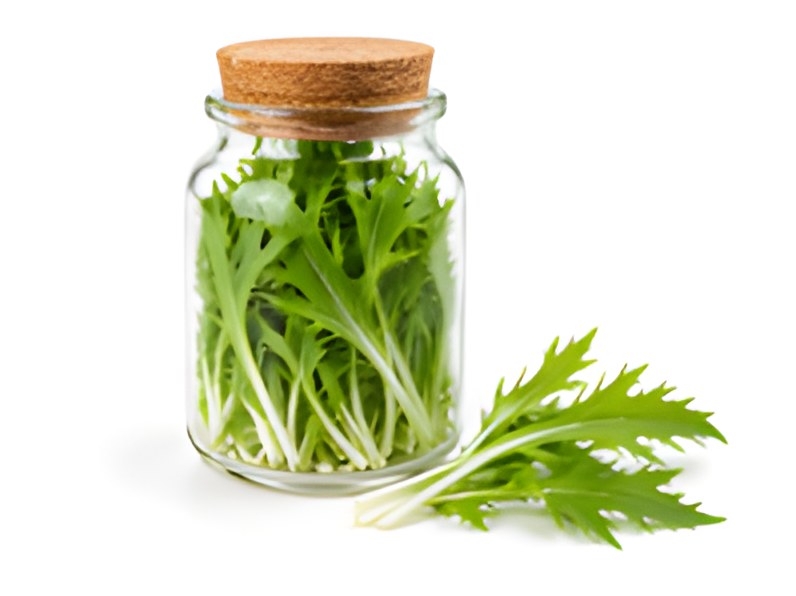
Mizuna is a leafy green from the mustard family with long, deeply cut, feathery leaves on thin white stems. Penn State Extension describes its flavor as mild and mustard-like with a peppery note, and UT Gardens calls it very mild for a mustard (Penn State Extension; UT Gardens). It is a common part of salad mixes, it can be cut young and allowed to regrow, and it has been tried in several hydroponic systems. Here's a brief overview of the plant and what the trials report.
What Mizuna Is
Mizuna is usually listed as Brassica rapa var. nipposinica (also written japonica), the same species as turnip and pak choi (Penn State Extension; UT Gardens). Other names include Japanese mustard greens, kyona, California peppergrass and spider mustard. Penn State notes it is thought to come from China but has been grown in Japan for centuries, and that the name means "water greens" in Japanese (Penn State Extension). The University of Florida's older fact sheet files the same green under Brassica juncea var. japonica (Stephens, UF/IFAS HS630), so seed catalogs and sources do not all agree on the name.
There are many varieties. Specialty Produce counts at least sixteen (Specialty Produce). Penn State lists 'Early' and 'Summer' with light green stems, 'Beni Houshi' and 'Japanese Pink' with purple stems, and 'Japanese Red Mustard' with dark purple leaves (Penn State Extension). 'Red Kingdom' was an All-America Selections edible winner in 2016 (UT Gardens). A full-grown plant can stand 12 to 18 inches tall and carry up to 180 leaves in a bunch about a foot across (Stephens, UF/IFAS HS630).
Nutritional Profile of Mizuna
We did not find a USDA FoodData Central record for mizuna by name. USDA's "mustard greens" entries are for Brassica juncea, so we have not copied those numbers here. Specialty Produce says the dark green leaves carry most of the plant's beta carotene, vitamins and minerals, but gives no amounts (Specialty Produce).
Nothing on this page is health or medical advice.
Hydroponics of Mizuna
What the Research Shows
The most detailed hydroponic trial we found is from the Bangladesh Agricultural Research Institute. Three mizuna varieties were grown in a deep water culture glasshouse trial (300-litre boxes) from late November to January, on three nutrient solutions: two modified Cooper's solutions at full strength, each at EC 1.5 dS/m, and Enshi-Shoho at half strength. Plants grew four to six weeks. On the first Cooper's solution, 'Late White Stem' reached 101.5 g fresh weight per plant and 'Salad Kyomizuna' 101.0 g; on the half-strength Enshi solution they reached 64.5 g and 78.5 g. 'Salad Kyomizuna' carried about 109 leaves per plant on the best solution, against about 18 for the variety called 'Mustard Green' (Asaduzzaman et al., 2023).
An Indonesian trial grew mizuna in an automatic NFT system with four different nutrient formulas and a plain-water control, and three timings for pausing the flow (15, 45 or 60 minutes off). All four formulas beat plain water, but the formulas did not differ from each other, and the three flow timings gave similar growth (Iriany et al., 2024). Our reading: mizuna is not fussy about the brand of nutrient, and short pauses in an NFT channel did not hurt it in that trial.
Feeding and pH
The tested figure is EC 1.5 dS/m in deep water (Asaduzzaman et al., 2023). That paper did not report solution pH. We found no pH trial on mizuna itself. A June 2026 Singapore Food Agency trial on Asian leafy vegetables in NFT found choy sum (another Brassica rapa green) grew best at pH 7.0, and xiao bai cai and gailan did equally well anywhere from 6.0 to 7.0, while lettuce did best at 6.0. The agency notes the usual 5.5-6.5 advice for leafy greens may not suit Asian leafy vegetables (Singapore Food Agency, 2026). Those are relatives, not mizuna. Our reading: start near EC 1.5 and pH 6.0-6.5, and don't chase a slow rise toward 7.
Light
In a University of Georgia growth-chamber trial, mizuna got the same daily light (16 mol/m²/day from white LEDs) spread over 10 to 20 hours at 20 °C with added CO₂. Plants were in pots of soilless mix on ebb-and-flow benches, fed at 100 mg/L nitrogen. Going from a 10-hour day at 444 µmol/m²/s to a 20-hour day at 222 µmol/m²/s raised above-ground growth by 18.7% at harvest, 30 days after sowing (Palmer & van Iersel, 2020). The authors suggest growers may get more leaf for the same light by running lights longer at a lower setting.
For microgreens, a 2016 study grew mizuna in hydroponic trays under LEDs at 105, 210 and 315 µmol/m²/s for 16 hours a day. Higher light gave shorter stems and a higher dry-matter share in mizuna, kohlrabi and mustard alike (Gerovac et al., 2016).
Temperature
Seeds germinate best at 55-75 °F and can sprout as low as 40 °F, and plants handle light frost (Penn State Extension). Mizuna is very slow to bolt, which is why it suits spring and fall (Penn State Extension; Stephens, UF/IFAS HS630), though UT Gardens found it tends to bolt once summer days stay at 90 °F or above (UT Gardens). A Ljubljana greenhouse thesis grew two mizuna varieties in NFT over winter, with and without a heated nutrient solution. The green variety did better with the heated solution (a calculated 33.6 t/ha against 19.8 t/ha unheated), but the red variety did not gain from the heat (Hribar, 2023). The thesis abstract does not give the solution temperatures.
Spacing
The Bangladesh deep-water trial set plants 15 cm apart in rows 36 cm apart (Asaduzzaman et al., 2023). In the garden, UF suggests thinning to 6 to 12 inches (Stephens, UF/IFAS HS630). An open-air hydroponic study tested 70 to 100 plants per square meter and found 90 plants per square meter gave the best yield (Tadevosyan, 2020, as reported by Vertical Farm Daily).
Harvest
Leaves are ready about three weeks after growth begins (Stephens, UF/IFAS HS630). Mizuna can be picked at any stage, from microgreen to baby leaf to full plant. For regrowth, cut 2 inches or more above the base; or cut the whole plant at once (Penn State Extension; UT Gardens).
Pests
UT Gardens found flea beetles were the only pest on mizuna in its Knoxville kitchen garden (UT Gardens). In Gainesville, small caterpillars stripped fall and winter plantings down to the midribs (Stephens, UF/IFAS HS630).
References
- Asaduzzaman, M., Ali, M. R., & Islam, F. (2023). Influence of three hydroponic nutrient solutions on the yield and quality of leafy vegetables grown in hydroponics culture. Bangladesh Journal of Agricultural Research, 48(2), 161-181. DOI 10.3329/bjar.v48i2.91659. Retrieved from https://banglajol.info/index.php/BJAR/article/view/91659
- D'Aurora, D. Mizuna: An Asian green. Penn State Extension. Retrieved from https://extension.psu.edu/mizuna-an-asian-green
- Gerovac, J. R., Craver, J. K., Boldt, J. K., & Lopez, R. G. (2016). Light intensity and quality from sole-source light-emitting diodes impact growth, morphology, and nutrient content of Brassica microgreens. HortScience, 51(5), 497-503. Summary retrieved from https://ars.usda.gov/ARSUserFiles/50820500/GPRG/2016PublicationsandSummaries/2016_Light%20Intensity%20and%20Quality%20from%20Solesource%20Light-emitting%20Diodes%20%5BSummary%5D.pdf
- Hribar, J. (2023). Gojenje listne zelenjave na NFT hidroponskem sistemu z ogrevano hranilno raztopino (Cultivation of leaf vegetables on NFT hydroponic system with heated nutrient solution). Diploma thesis, University of Ljubljana, Biotechnical Faculty. Retrieved from https://repozitorij.uni-lj.si/IzpisGradiva.php?id=152312
- Iriany, A., Muhidin, Machmudi, & Hasanah, F. (2024). Optimization of nutrient formulation and medium flow using automatic nutrient film technique hydroponics system on mizuna (Brassica rapa Nipponisica) cultivation. BIO Web of Conferences, 143, 01018. Retrieved from https://www.bio-conferences.org/articles/bioconf/abs/2024/62/bioconf_iconbeat2024_01018/bioconf_iconbeat2024_01018.html
- Jones, H. (2018). UT Gardens' October 2018 Plant of the Month: Mizuna. UT Gardens. Retrieved from https://utgardens.tennessee.edu/?p=3355
- Palmer, S., & van Iersel, M. W. (2020). Increasing growth of lettuce and mizuna under sole-source LED lighting using longer photoperiods with the same daily light integral. Agronomy, 10(11), 1659. Retrieved from https://www.mdpi.com/2073-4395/10/11/1659/htm
- Singapore Food Agency (2026). Optimising pH for higher yields in hydroponic Asian leafy vegetables (best practice guide). Retrieved from https://www.sfa.gov.sg/docs/default-source/food-science-and-technology/optimizingphydroponicsasianleafyvegetables_bestpracticeguide_jun2026.pdf
- Specialty Produce. Mizuna. Retrieved from https://specialtyproduce.com/produce/Mizuna_6295.php
- Stephens, J. M. Mustard, potherb: Brassica juncea (L.) Czern. var. japonica (Thunb.) Bailey. UF/IFAS Extension, HS630. Retrieved from https://edis.ifas.ufl.edu/pdffiles/MV/MV09700.pdf
- Tadevosyan, A. (2020). The growth and yield of the vegetable mizuna in open-air hydroponics. Journal of Food & Nutritional Disorders. As reported by Vertical Farm Daily. Retrieved from https://verticalfarmdaily.com/article/9442324/the-growth-and-yield-of-the-vegetable-mizuna-in-open-air-hydroponics
Keep reading

Growing Onions Hydroponically
In the scientific community, onion goes by the name of Allium cepa. Onion is more commonly known as a culinary and therapeutic spice in the kitchen when crushed into powdered form. The…

Growing Pepper Hydroponically
Pepper family is normally consumed as a spice. But, in some cultures, its fruit is used as whole foods. The family has well over 25 members, but this discussion is limited to…

Growing Celery Hydroponically
Celery belongs to the same family as one of the most common whole foods, carrots. From stalk to leaves, every part of celery is edible and often used as a spice for…