
Home / The Dirt / Hydroponic greens and vegetables / Growing Radish Hydroponically
Growing Radish Hydroponically
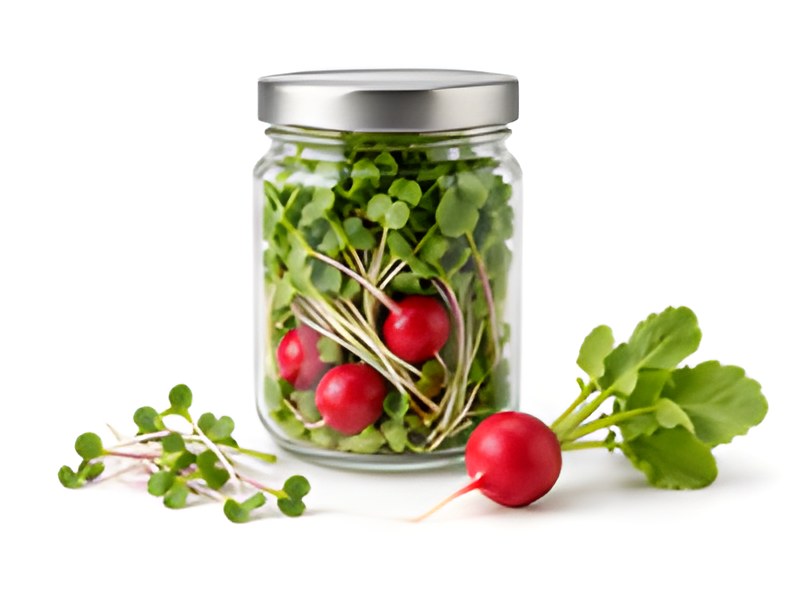
Radish is a quick, cool-season crop: small spring radishes are ready in three to five weeks, and radish microgreens in a little over a week. Hydroponic growers mostly grow it as a microgreen, but it can also be grown to a full root on a floating raft. Here's a brief overview of the plant and what the research reports.
What Radish Is
Radish, Raphanus sativus, is in the mustard family. University of Maryland Extension groups it into small spring radishes, Asian daikon and winter storage types, and notes that spring radishes are usually pulled at about one inch across. The leaves and seed pods are edible too, especially those of the 'Rat-Tailed' cultivar (University of Maryland Extension, Growing Radishes in a Home Garden).
Texas A&M AgriLife Extension lists common spring radishes such as Cherry Belle, Champion, Early Scarlet Globe, Easter Egg, French Breakfast, Sparkler and White Icicle, along with Black Spanish and Chinese White Winter and two daikons (Masabni, Texas AgriLife Extension, Radish). Oregon State University Extension adds Comet, Fuego, Burpee White and Faribo White Snowball (Oregon State University Extension, Radishes).
Nutritional Profile of Radish
USDA FoodData Central (FDC 169276, SR Legacy) lists raw radish root per 100 g at 16 kcal, 95.3 g water, 0.68 g protein, 0.10 g fat, 3.40 g carbohydrate and 1.6 g fiber. It also lists 25 mg calcium, 0.34 mg iron, 10 mg magnesium, 20 mg phosphorus, 233 mg potassium, 14.8 mg vitamin C and 25 µg folate (USDA FoodData Central via GetFoodFacts, Radishes, raw). Nothing on this page is health or medical advice.
Hydroponics of Radish
What the Research Shows
Full roots on a floating raft. Salerno and colleagues (2007) at the University of Tuscia experimental farm in central Italy grew the radish cultivars Girox and Suprella in a floating system in an unheated greenhouse, at 720 plants per square metre, for three back-to-back crops in spring and summer 2005. They compared full, three-quarter and half-strength nutrient solution. Three-quarter strength gave the best yield in spring and half strength gave the best yield in summer. The abstract gives no EC, pH or yield figures.
Feed strength in a substrate system. In a 2019 undergraduate thesis at the Federal University of Ceará in Brazil, dos Santos grew radish in a 3:1 mix of coconut fibre and rice husk, fed with nutrient solutions set by EC. Two greenhouse trials covered EC 1.0 to 1.8 dS/m and EC 2.0 to 2.8 dS/m. Radish gave good root yields at EC 1.6 to 1.8 dS/m (dos Santos, 2019).
How much feed microgreens need. Keutgen, Hausknecht, Tomaszewska-Sowa and Keutgen (2021) grew radish cress microgreens on full, half and quarter-strength Hoagland solution, tap water, or demineralized water. Stems were longest on full Hoagland (5.97 cm), then half (5.14 cm) and quarter strength (4.60 cm), with tap water at 3.65 cm and demineralized water at 2.71 cm. Stem nitrate fell from 23.33 g/kg dry matter on full Hoagland to 6.03 on quarter strength and next to nothing (0.14) on tap water.
Keep the nutrient solution clean. Settanni, Miceli, Francesca, Cruciata and Moschetti (2013) added eight spoilage and disease-causing bacteria to the nutrient solution of hydroponic radish in a greenhouse and followed them through one crop. The added bacteria declined in the solution, but three of them (Citrobacter freundii, an Enterobacter and Klebsiella oxytoca) were recovered alive from the radishes at harvest, which the authors took to mean the plants had taken them up. For a home grower the practical point is simple: start with clean water and clean tanks.
Our reading: radish does well on a weaker feed than many leafy crops. On a raft, three-quarter strength in cool weather and half strength in summer did best; in substrate, EC 1.6 to 1.8 gave good roots. As a microgreen it grows on plain tap water, and more feed gives taller shoots but much more nitrate. No study we read gave a tested pH; the usual 5.5 to 6.5 for hydroponic vegetables is our estimate, not a tested figure.
Starting Plants
Maryland Extension says to sow seed 1/4 to 1/2 inch deep and 1 to 2 inches apart, then thin to 2 to 4 inches apart depending on type (University of Maryland Extension, Growing Radishes in a Home Garden). Oregon State suggests sowing a few seeds every 10 days for a longer harvest (Oregon State University Extension, Radishes).
Light and Temperature
Texas A&M calls radish a cool-season crop that prefers 40 to 70 °F, with an optimum of 60 to 65 °F (Masabni, Texas AgriLife Extension, Radish). Maryland Extension notes that rising temperatures and hot weather make the roots spicy and woody (University of Maryland Extension, Growing Radishes in a Home Garden). The raft trial above also found that the best feed strength changed between spring and summer (Salerno et al., 2007).
Harvest
Texas A&M lists 20 to 35 days from planting and Maryland 25 to 35 days for spring radishes. Oregon State says three to six weeks depending on variety, and warns that roots left too long may crack, turn spongy or woody, and taste hot (Oregon State University Extension, Radishes).
Pests
Texas A&M lists damping-off, downy mildew, bacterial leaf spot, white rust and nematodes, and aphids, cabbage loopers and flea beetles (Masabni, Texas AgriLife Extension, Radish). Oregon State suggests row covers for flea beetles and a hard spray of water for aphids (Oregon State University Extension, Radishes).
Storage
Oregon State says to cut the greens from the roots and refrigerate them separately: greens within 3 days, roots within 2 weeks (Oregon State University Extension, Radishes). Texas A&M gives about 1 week at 45 °F and 95-100% humidity for bunched radishes, and 3 to 4 weeks at 40 °F for topped radishes (Masabni, Texas AgriLife Extension, Radish).
References
- dos Santos, A. V. A. (2019). Concentração de macronutrientes na solução nutritiva no cultivo de rabanete em hidroponia com substrato [Macronutrient concentration in nutrient solution in radish hydroponic cultivation with substrate]. Undergraduate thesis, Universidade Federal do Ceará. Retrieved from https://repositorio.ufc.br/handle/riufc/50474?locale=en
- Keutgen, N., Hausknecht, M., Tomaszewska-Sowa, M., & Keutgen, A. J. (2021). Nutritional and Sensory Quality of Two Types of Cress Microgreens Depending on the Mineral Nutrition. Agronomy, 11(6), 1110. DOI 10.3390/agronomy11061110. Retrieved from https://www.mdpi.com/2073-4395/11/6/1110
- Masabni, J. Radish. Texas AgriLife Extension Service. Retrieved from https://aggie-horticulture.tamu.edu/vegetable/files/2011/10/radish.pdf
- Oregon State University Extension Service. Radishes. Retrieved from https://extension.oregonstate.edu/es/imported-publication/radishes
- Salerno, A., Rea, E., Pierandrei, F., Rinaldi, S., Rivera, C. M., Colla, G., & Saccardo, F. (2007). Yield Response of Radish Grown in a Floating System to Nutrient Solution Concentration. Acta Horticulturae, 747, 161-170. DOI 10.17660/ActaHortic.2007.747.17. Retrieved from https://ishs.org/ishs-article/747_17/
- Settanni, L., Miceli, A., Francesca, N., Cruciata, M., & Moschetti, G. (2013). Microbiological investigation of Raphanus sativus L. grown hydroponically in nutrient solutions contaminated with spoilage and pathogenic bacteria. International Journal of Food Microbiology, 160(3), 344-352. DOI 10.1016/j.ijfoodmicro.2012.11.011. Retrieved from https://agris.fao.org/search/en/records/65de2abc0f3e94b9e5cb654e
- University of Maryland Extension. Growing Radishes in a Home Garden. Retrieved from https://extension.umd.edu/resource/growing-radishes-home-garden
- USDA FoodData Central. Radishes, raw (FDC 169276, SR Legacy). Retrieved from https://getfoodfacts.com/food/radishes-raw-169276
Keep reading

Growing Onions Hydroponically
In the scientific community, onion goes by the name of Allium cepa. Onion is more commonly known as a culinary and therapeutic spice in the kitchen when crushed into powdered form. The…

Growing Pepper Hydroponically
Pepper family is normally consumed as a spice. But, in some cultures, its fruit is used as whole foods. The family has well over 25 members, but this discussion is limited to…

Growing Celery Hydroponically
Celery belongs to the same family as one of the most common whole foods, carrots. From stalk to leaves, every part of celery is edible and often used as a spice for…