
Home / The Dirt / Hydroponic greens and vegetables / Growing Swiss Chard Hydroponically
Growing Swiss Chard Hydroponically
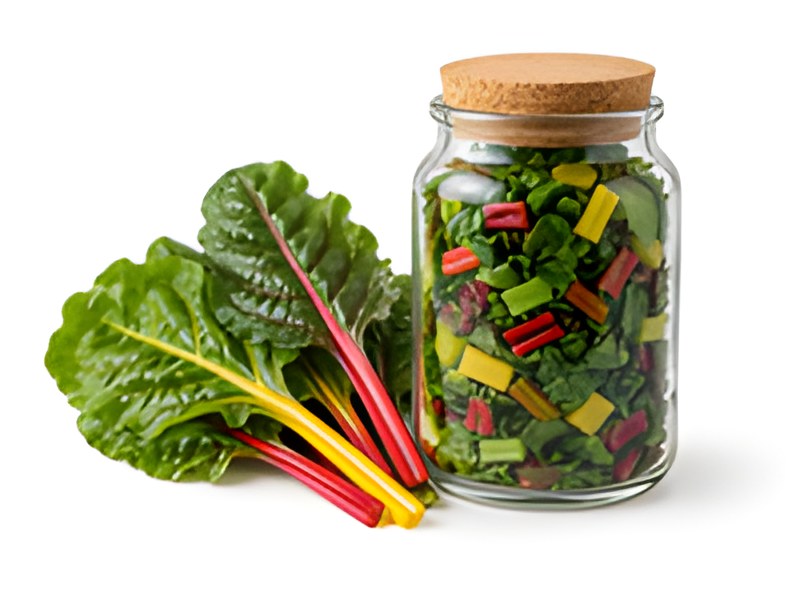
Swiss chard is a beet that was bred for its leaves instead of its root. It grows in NFT channels as easily as lettuce, and you can cut a few outer leaves at a time for weeks. Its red, yellow and white stems make it one of the brightest crops in a grow room. Here's a brief overview of the plant and what the hydroponic trials report.
What Swiss Chard Is
University of Wisconsin Extension names chard Beta vulgaris var. cicla, "a type of beet that does not produce an edible root," grown for its leaves and leaf stalks (petioles). It is native to the Mediterranean and was eaten before the Roman Empire (Mahr, UW Extension). University of Arkansas Extension lists Fordhook Giant and Lucullus (white stems), Bright Lights (multicolored stems), Rhubarb (red stems) and Orea (golden stems) among its cultivars (Andersen, UA FSA6065).
Nutritional Profile of Swiss Chard
USDA's SR Legacy record for raw Swiss chard (FDC 169991, via GetFoodFacts) lists, per 100 g, about 19 kcal, 92.7 g water, 1.8 g protein, 1.6 g fiber, 30 mg vitamin C, 830 µg vitamin K, 306 µg vitamin A (RAE), 81 mg magnesium, 379 mg potassium, 213 mg sodium, 51 mg calcium and 1.8 mg iron (GetFoodFacts, USDA FDC 169991). Nothing on this page is health or medical advice.
Hydroponics of Swiss Chard
What the Research Shows
Ten cultivars in NFT. In Oklahoma State University greenhouses in Stillwater, ten chard cultivars were grown on recirculating NFT tables at EC 1.5-2.5 mS/cm and pH 5.5-6.5, with the heat set at 21 °C days and 18 °C nights and no extra lighting (about 12.4 mol/m²/day of daylight). Plants were sown at the end of October 2023 and measured 37 days after transplanting. 'Bright Yellow' (51.3 g shoot fresh weight), 'Peppermint' (51.0 g) and 'Sea Foam' (51.0 g) grew the most, and 'Cardinal' the least (29.5 g). 'Fordhook Giant' had the most provitamin A in its leaves, and in most cultivars the stems held more provitamin A than the leaves. Leaves generally held more minerals than stems, except potassium (Moccio & Dunn, 2025).
Fertilizer brand mattered less than cultivar. An earlier NFT trial by the same lead researcher grew lettuce, basil and chard on two fertilizers (5-4.8-21.6 and 5-5.2-21.6 as N-P-K). For chard, yield changed with cultivar but not with fertilizer, 'Fordhook Giant' gave the most fresh weight on both, and leaf nutrient levels sat in the recommended range on both (Singh et al., 2019). A 2017 conference abstract from the same kind of trial, at EC 1.5-2.5 and pH 5.5-6.5 with harvest 45 days after transplanting, compared 'Rainbow', 'Barese' and 'Fordhook Giant' on three fertilizers; 'Fordhook Giant' had the highest fresh weight on all three (ASHS, 2017).
Our reading: EC 1.5-2.5 and pH 5.5-6.5 is the range every chard trial here used. If you want the most leaf, the trials point to 'Fordhook Giant' among the classic cultivars and 'Bright Yellow' or 'Peppermint' among the colored ones. Choose the color you like first: the fertilizer brand made little difference.
Temperature
UW Extension says chard prefers cool weather: high heat slows leaf growth, though it takes heat better than spinach. It keeps growing through frost until temperatures fall to the mid-20s °F, and it "rarely bolts like spinach will" (Mahr, UW Extension). Arkansas Extension calls it a cool-to-warm crop whose seedlings tolerate moderate frost (Andersen, UA FSA6065). The Oklahoma NFT trial ran at about 21 °C (Moccio & Dunn, 2025).
Spacing
Arkansas Extension sets transplants 9 to 12 inches apart, or thins sown seedlings to 4 to 6 inches (Andersen, UA FSA6065).
Harvest
Arkansas Extension lists 55 days to maturity for Bright Lights and 60 days for Fordhook Giant, Lucullus, Rhubarb and Orea. Cut the outer leaves 1½ inches above the base while they are young and tender (about 8 to 12 inches long), and take care not to damage the growing tip in the center (Andersen, UA FSA6065). UW Extension says you can start picking leaves about 3 inches long roughly four weeks after planting, or cut the whole plant 3 inches up for one bunch harvest about two months from planting. Pick early or late in the day, since leaves wilt quickly in warm sun, and keep removing older leaves for milder new growth (Mahr, UW Extension).
Pests
UW Extension reports few insect or disease problems; aphids and spinach leafminer sometimes show up, and lamb's-quarters weeds can host the leafminer (Mahr, UW Extension).
Storage
Unwashed chard keeps one to two weeks in the refrigerator (Mahr, UW Extension).
References
- Andersen, C. R. Home Gardening Series: Chard. University of Arkansas Division of Agriculture, FSA6065. Retrieved from https://www.uaex.uada.edu/publications/PDF/FSA-6065.pdf
- ASHS (2017). Fertilizer and Cultivar Selection for Lettuce, Basil, and Swiss Chard Using Nutrient Film Technique. 2017 ASHS Annual Conference abstract (authors not listed on the page). Retrieved from https://ashs.confex.com/ashs/2017/webprogramarchives/Paper27084.html
- GetFoodFacts. Chard, swiss, raw (USDA FoodData Central SR Legacy, FDC 169991). Retrieved from https://getfoodfacts.com/food/chard-swiss-raw-169991
- Mahr, S. Swiss Chard. University of Wisconsin-Madison Division of Extension. Retrieved from https://hort.extension.wisc.edu/articles/swiss-chard/
- Moccio, M., & Dunn, B. L. (2025). Provitamin A, Nutrient Analysis, and Plant Growth of Hydroponically Grown Swiss Chard Cultivars. HortScience, 60(6), 967-969. DOI 10.21273/HORTSCI18556-25. Retrieved from https://journals.ashs.org/view/journals/hortsci/60/6/article-p967.xml
- Singh, H., Dunn, B., Payton, M., & Brandenberger, L. (2019). Fertilizer and Cultivar Selection of Lettuce, Basil, and Swiss Chard for Hydroponic Production. HortTechnology, 29(1), 50-56. DOI 10.21273/HORTTECH04178-18. Retrieved from https://doaj.org/article/f24d9badd7354750b975fef80be699bf
Keep reading

Growing Onions Hydroponically
In the scientific community, onion goes by the name of Allium cepa. Onion is more commonly known as a culinary and therapeutic spice in the kitchen when crushed into powdered form. The…

Growing Pepper Hydroponically
Pepper family is normally consumed as a spice. But, in some cultures, its fruit is used as whole foods. The family has well over 25 members, but this discussion is limited to…

Growing Celery Hydroponically
Celery belongs to the same family as one of the most common whole foods, carrots. From stalk to leaves, every part of celery is edible and often used as a spice for…