
Home / The Dirt / Hydroponic greens and vegetables / Growing Tatsoi Hydroponically
Growing Tatsoi Hydroponically
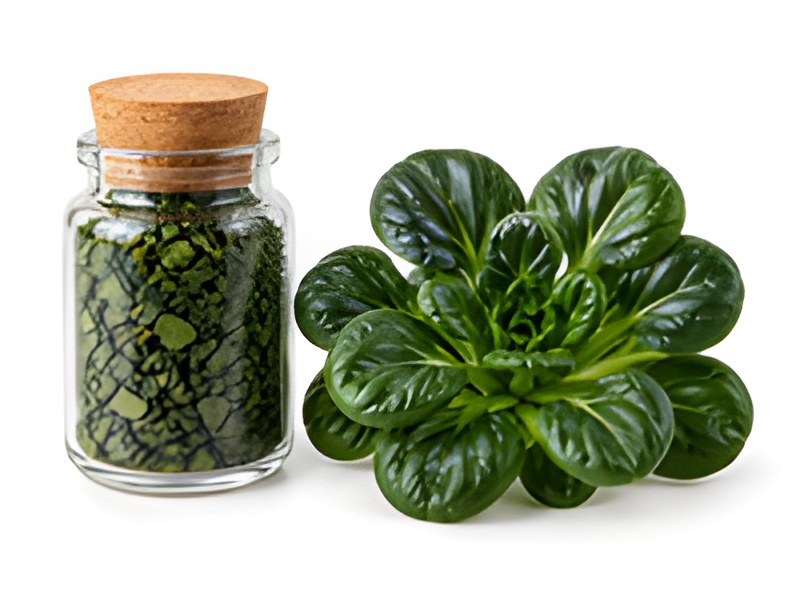
Tatsoi is a low, flat rosette of dark green, spoon-shaped leaves. It is the same species as the turnip and bok choy, it can be cut young as baby leaf or grown out to a full head, and it has been tested in several hydroponic setups. Here's a brief overview of the plant and what the trials report.
What Tatsoi Is
Tatsoi is Brassica rapa in the narinosa group (SARE), written by Seedy Farm as B. rapa subsp. narinosa or var. rosularis. It also goes by spoon mustard, spinach mustard, Chinese flat cabbage and rosette bok choy (Seedy Farm). Seedy Farm describes it as native to East Asia and grown since at least 500 A.D.; it is a cool-season biennial usually grown as an annual, forming a rosette 15-31 cm across (Seedy Farm).
A paper in an Indonesian journal notes that a 'Pagoda' type of tatsoi is rare in local markets and sells at a relatively high price (Putra et al., 2023).
Nutritional Profile of Tatsoi
We did not find a USDA FoodData Central record for tatsoi, so we are not borrowing numbers from another green here. Nothing on this page is health or medical advice.
Hydroponics of Tatsoi
What the Research Shows
Tatsoi has more hydroponic trials behind it than most of the greens on this site, mostly from Vietnam.
At Can Tho University, a 2025 greenhouse trial grew tatsoi on static floating rafts (foam boards with net pots) at 20 × 20 cm. Seedlings went onto the rafts 16 days after sowing and were harvested at 46 days. The solution was held at about 1,200 ppm TDS and pH 5.5-6.0. A commercial solution gave 97.8 g per plant and 3.03 kg/m² marketable yield; a leafy-vegetable formula with added iron did about as well (95.7 g, 2.96 kg/m²); the same formula without the added iron gave 79.5 g and 2.43 kg/m² (Phan & Nguyen, 2025).
An earlier trial by the same university, also in a nethouse with one plant per basket, compared four solutions. An improved Hoagland solution gave the most (134 g per plant, 3.34 kg/m² marketable), a commercial solution came close (126 g, 3.15 kg/m²), and standard Hoagland gave the shortest plants with the fewest and narrowest leaves. Nitrate in the leaves differed between solutions but stayed under the maximum allowed for safe vegetables in every case (Nguyen et al., 2022). The abstract gives no EC or pH.
A wick-system trial published in an Indonesian journal tested four media (rockwool, rice-husk charcoal, cocopeat, sawdust) at EC 1.5, 2.5 and 3.5. Cocopeat at EC 3.5 gave the heaviest plants, 187.08 g fresh and 141.08 g marketable (Putra et al., 2023). The abstract gives no numbers for the other combinations.
Our reading: tatsoi responds to a full-strength, complete solution. A plain textbook Hoagland mix gave the smallest plants in the 2022 Can Tho trial, and in the wick trial the strongest solution tested did best. Holding pH at 5.5-6.0, as the 2025 raft trial did, is a tested starting point.
Fish Water
A 2024 master's thesis at the Swedish University of Agricultural Sciences mixed tilapia tank water with Hoagland solution for tatsoi. In liquid hydroponics, a 50/50 mix grew about as well as plain nutrient solution; in peat the yields fell, because the peat held on to nutrients. More fish water meant lower EC, potassium and magnesium, and less available calcium in the liquid system (D'ercole, 2024). The abstract gives no yield figures.
Our reading: if you run an aquaponic tank, tatsoi can share fish water, but top it up with nutrient solution rather than using fish water alone.
Baby Leaf
In a plant-factory study published in a Korean journal, tatsoi was one of four baby-leaf crops sown in urethane sponges under 110 µmol/m²/s light for 16 hours a day at 25/20 °C. Plants had tap water for the first 7 days and a nutrient solution for the next 7, and were cut at 14 days. Fresh weight was highest on the Yamazaki lettuce solution (Growth and Quality of Baby Leaf Vegetables, 2015). The abstract gives no tatsoi numbers.
Seedy Farm says tatsoi adapts readily to hydroponic systems, recommends one seed per pod, and advises keeping grow lights fairly close early on so the plant stays a low, spreading rosette instead of stretching; baby leaves can be cut from about 20 days (Seedy Farm).
Temperature
Seeds germinate best at a soil temperature of 18-22 °C and usually come up in 4-8 days; leaf quality is best at 16-21 °C (Seedy Farm). SARE gives 65-75 °F (about 18-24 °C) for both germination and growth of transplants (SARE). Sustained heat above about 27 °C, drought stress, cold snaps on young plants and lengthening days can all trigger bolting (Seedy Farm). SARE calls it a poor performer in hot, dry weather and best as a fall crop (SARE).
Spacing
Seedy Farm gives 15-20 cm between plants for a standard harvest, up to 25-30 cm for large rosettes, and 7.5-10 cm for baby leaf (Seedy Farm). The 2025 raft trial used 20 × 20 cm (Phan & Nguyen, 2025).
Harvest
Baby leaves are ready in about 21-30 days from sowing and full rosettes in about 45-50 days (Seedy Farm). SARE harvests when plants are about 4-6 inches (10-15 cm) tall with dark green leaves, either as bunches cut by hand or as whole heads like bok choy (SARE). Cut-and-come-again picking of the outer leaves also works (Seedy Farm).
Storage
SARE stores tatsoi at 32-42 °F (0-6 °C) and 95-98% humidity, and warns that it is very sensitive to ethylene, which yellows the leaves, so keep it away from ethylene-producing crops (SARE). Seedy Farm notes that it does not freeze well (Seedy Farm).
Pests
Flea beetles, cabbage worms and diamondback moths, cabbage maggots and cutworms are the main pests SARE lists, with row covers or insect netting as the first defense (SARE). Seedy Farm adds aphids, slugs and snails (Seedy Farm).
References
- D'ercole, R. (2024). Impacts of fish effluent enrichment with hydroponics solution on tatsoi cultivation in soilless systems. Master's thesis, Swedish University of Agricultural Sciences, Alnarp. Retrieved from https://stud.epsilon.slu.se/20789/
- Growth and quality of baby leaf vegetables hydroponically grown in plant factory as affected by composition of nutrient solution (2015). Protected Horticulture and Plant Factory, 24(4), 271-274. Record retrieved from https://s-space.snu.ac.kr/handle/10371/95454
- Nguyen, H. T., Ha, M. C., Bui, V. L., Nguyen, T. N. Y., & Phan, N. N. (2022). Effects of nutrient solutions on growth and yield of tatsoi (Brassica rapa var. narinosa) grown in hydroponics system. Vietnam Journal of Agricultural Science and Technology, 08(141), 48-55. Retrieved from https://tapchi.vaas.vn/vi/tap-chi/anh-huong-cua-dung-dich-dinh-duong-den-sinh-truong-va-nang-suat-cai-tatsoi-brassica-rapa
- Phan, N. N., & Nguyen, H. T. Q. (2025). Effects of nutrient solution formulations on growth and yield of hydroponics tatsoi (Brassica rapa var. narinosa) and red pak choi (Brassica rapa var. chinensis) cultivated in greenhouse. TNU Journal of Science and Technology, 230(13), 275-282. DOI 10.34238/tnu-jst.12371. Retrieved from https://jst.tnu.edu.vn/jst/article/download/12371/pdf
- Putra, R. W., Syah, B., & Laksono, R. A. (2023). Pengaruh kombinasi media tanam organik dan nilai EC larutan nutrisi terhadap pertumbuhan dan hasil tanaman sawi (Brassica narinosa L.H. Bailey) varietas Pagoda pada hidroponik sistem wick. Jurnal Agrotech, 13(2). Retrieved from https://garuda.kemdiktisaintek.go.id/documents/detail/5541147
- SARE. Tatsoi. In Courtens, J.-P., The Northeast Crop Production and Harvest Manual. Retrieved from https://www.sare.org/publications/northeast-crop-production-harvest-manual/tatsoi/
- Seedy Farm. Tatsoi growing guide. Retrieved from https://seedy.farm/growing-guide/tatsoi
Keep reading

Growing Onions Hydroponically
In the scientific community, onion goes by the name of Allium cepa. Onion is more commonly known as a culinary and therapeutic spice in the kitchen when crushed into powdered form. The…

Growing Pepper Hydroponically
Pepper family is normally consumed as a spice. But, in some cultures, its fruit is used as whole foods. The family has well over 25 members, but this discussion is limited to…

Growing Celery Hydroponically
Celery belongs to the same family as one of the most common whole foods, carrots. From stalk to leaves, every part of celery is edible and often used as a spice for…